Mosher Alumni Hall
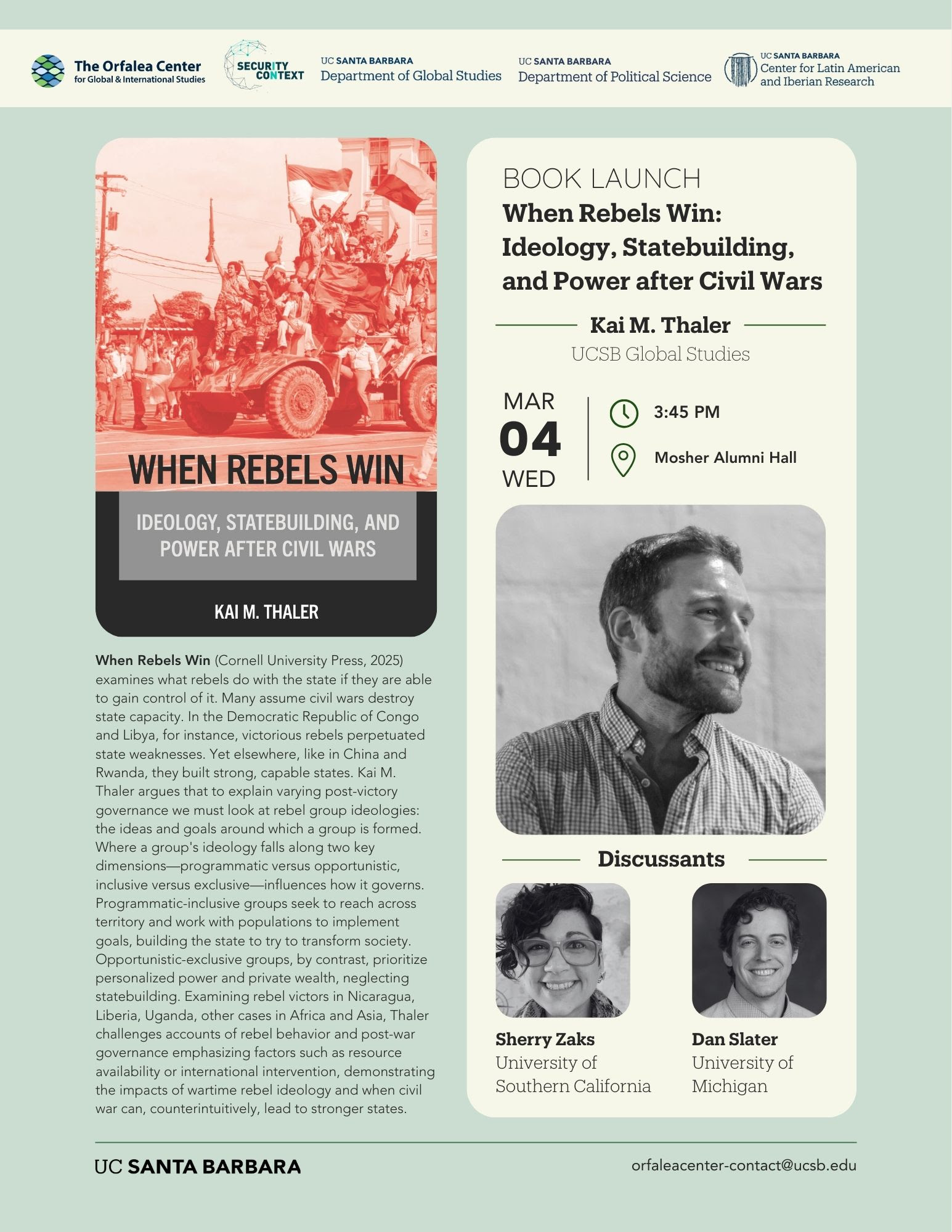
When Rebels Win (Cornell University Press, 2025) examines what rebels do with the state if they are able to gain control of it. Many assume civil wars destroy state capacity. In the Democratic Republic of Congo and Libya, for instance, victorious rebels perpetuated state weaknesses. Yet elsewhere, like in China and Rwanda, they built strong, capable states. Kai M. Thaler argues that to explain varying post-victory governance we must look at rebel group ideologies: the ideas and goals around which a group is formed. Where a group's ideology falls along two key dimensions—programmatic versus opportunistic, inclusive versus exclusive—influences how it governs. Programmatic-inclusive groups seek to reach across territory and work with populations to implement goals, building the state to try to transform society. Opportunistic-exclusive groups, by contrast, prioritize personalized power and private wealth, neglecting statebuilding. Examining rebel victors in Nicaragua, Liberia, Uganda, other cases in Africa and Asia, Thaler challenges accounts of rebel behavior and post-war governance emphasizing factors such as resource availability or international intervention, demonstrating the impacts of wartime rebel ideology and when civil war can, counterintuitively, lead to stronger states.
Discussants:
Sherry Zaks (University of Southern California)
Dan Slater (University of Michigan)