Girvetz 2320
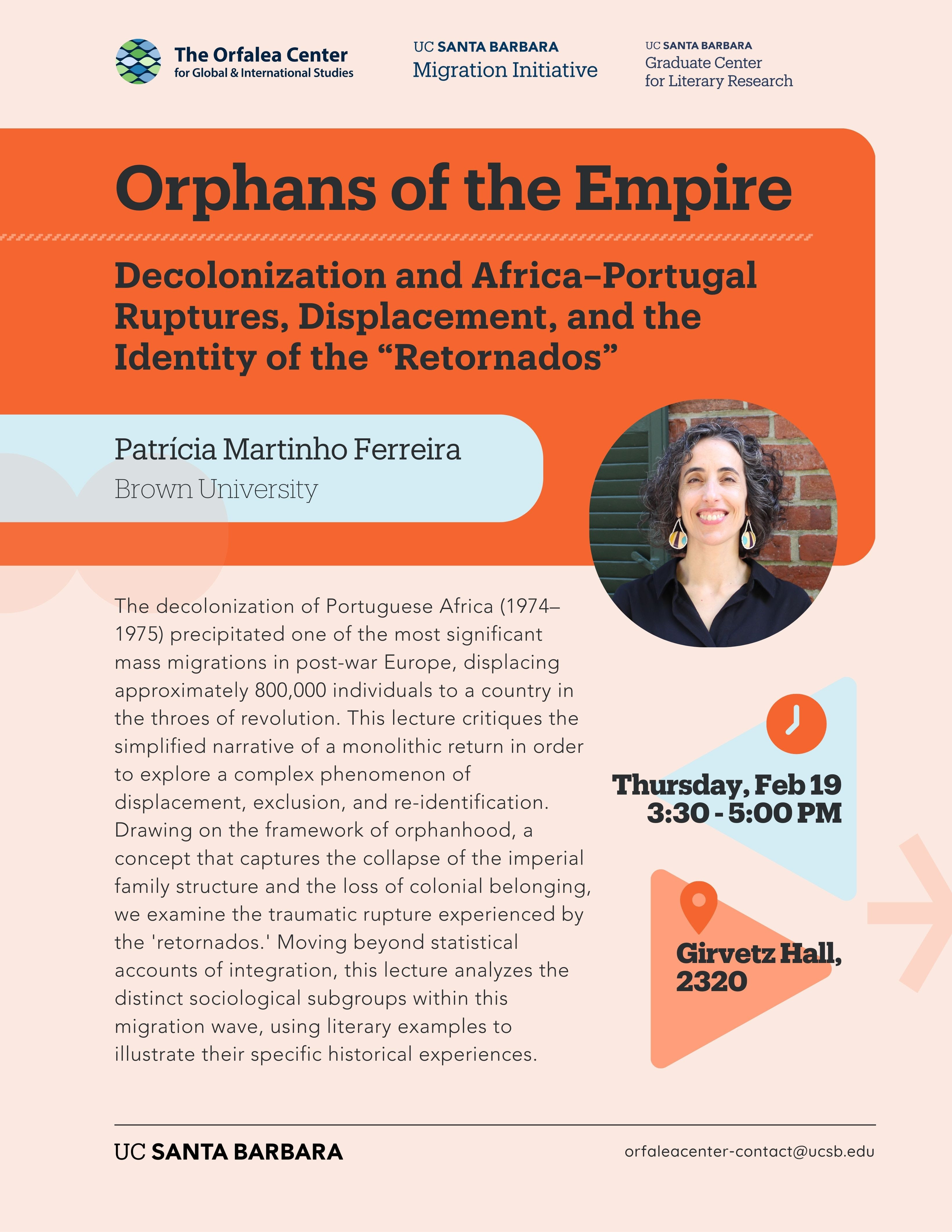
The decolonization of Portuguese Africa (1974–1975) precipitated one of the most significant mass migrations in post-war Europe, displacing approximately 800,000 individuals to a country in the throes of revolution. This lecture by Patrícia Martinho Ferreira (Brown Univ.) critiques the simplified narrative of a monolithic return in order to explore a complex phenomenon of displacement, exclusion, and re-identification. Drawing on the framework of orphanhood, a concept that captures the collapse of the imperial family structure and the loss of colonial belonging, we examine the traumatic rupture experienced by the retornados. Moving beyond statistical accounts of integration, this lecture analyzes the distinct sociological subgroups within this migration wave, using literary examples to illustrate their specific historical experiences. It first addresses the colonos-emigrantes, primarily economic migrants who escaped poverty for Africa only to experience the return as an exile marked by loss of status. It then examines African-born white heirs of the empire, who suffered a double orphanhood, bereft of their African birthplace and alienated from an ancestral motherland they had never known. Finally, particular attention is paid to the experiences of mixed-race descendants, as well as of Black migrants, who faced forms of exclusion that laid bare the contradictions of the persistent myth of Lusotropicalism. By mapping this affective cartography, this lecture argues that the retorno was not merely a demographic shift but a restructuring event that forced a painful, often silent, renegotiation of contemporary Portuguese identity.